Infrastructure DevOps
A Strategic Performance Analysis of Octopus Deploy and GitHub Synergy
In the contemporary U.S. IT landscape, the friction between development lifecycles and infrastructure operations remains a primary inhibitor of business scalability. The challenges associated with sluggish release cycles and critical errors during manual deployments within complex, distributed environments are far more than technical hurdles; they represent direct financial risks that artificially inflate Time-to-Market. By mid-2025, Infrastructure DevOps has transitioned from an innovative trend to a fundamental requirement for organizational survival. The deep integration of Octopus Deploy, GitHub, and Jira demonstrates how comprehensive automation of the Software Development Life Cycle (SDLC) can radically transform IT performance, turning chaotic manual interventions into a predictable, high-output value delivery pipeline.
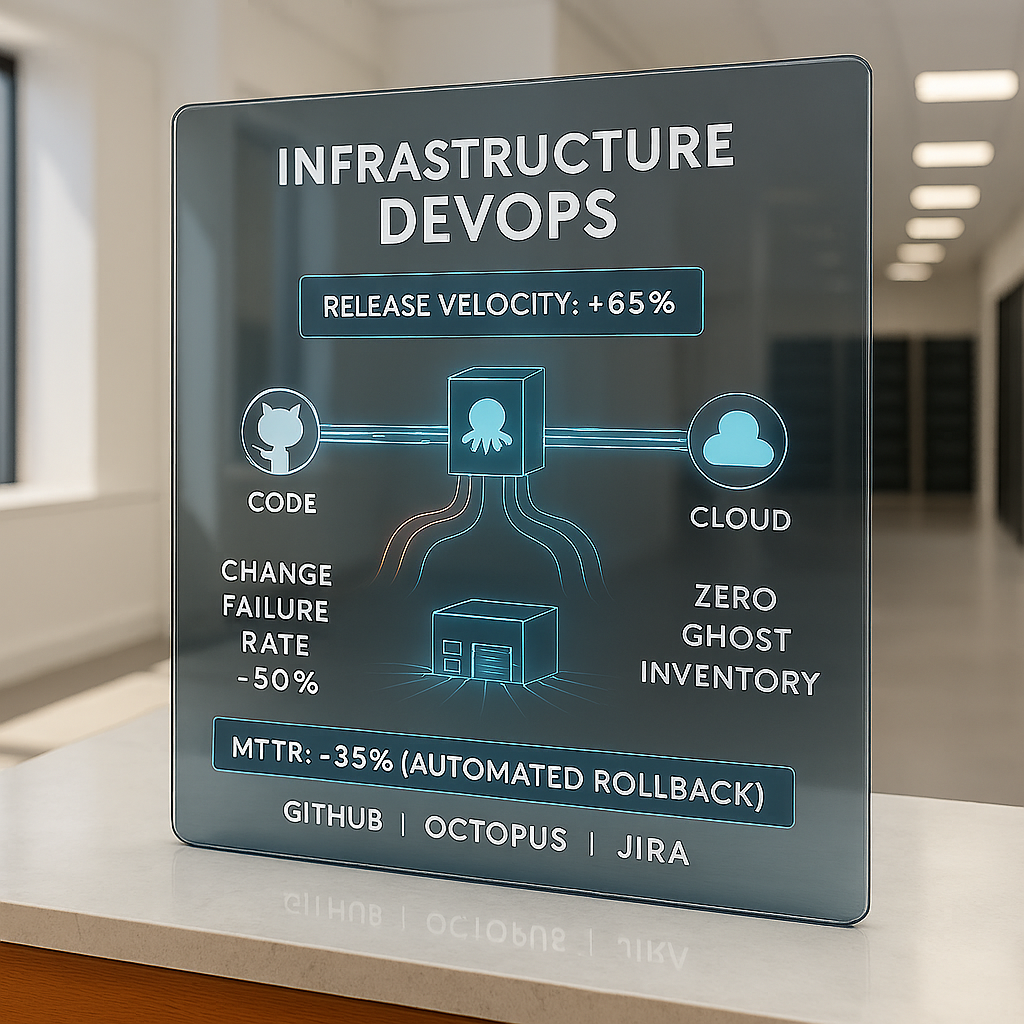
Prior to the implementation of an automated CI/CD pipeline, performance analysis revealed that up to 40% of engineering bandwidth was consumed by remediating configuration errors caused by human factors during manual code promotion across Dev, Staging, and Production environments. Utilizing GitHub as the Single Source of Truth and Octopus Deploy as a robust release orchestrator effectively eliminated “configuration drift.” Integrating these tools with Jira provided end-to-end visibility for every change traceable from a backlog ticket to a specific cloud instance. This synergy resulted in a 65% reduction in release preparation and execution time, enabling deployment frequency to scale from bi-weekly intervals to multiple daily releases without compromising system stability. The quantitative success of this efficiency is further validated by a 50% decrease in the Change Failure Rate within the first six months of operation, liberating significant resources for product innovation.
The technological complexity of this initiative involved engineering a seamless data flow between planning and execution tiers. Automation, in this context, is not merely about scripting; it is about establishing “Quality Gates” at every stage of the pipeline. By leveraging GitHub Actions for continuous integration alongside Octopus Deploy for complex deployments into hybrid cloud environments, we implemented automated security checks and performance testing prior to production entry. Analytical data indicates that this Site Reliability Engineering (SRE) approach reduced the Mean Time to Recovery (MTTR) by 35%, as Octopus Deploy’s automated rollback mechanisms trigger instantaneously upon detecting health metric deviations. This ensures a level of operational resilience that is unattainable through traditional infrastructure management.
By June 2025, the U.S. market has reached a clear consensus: Infrastructure DevOps is primarily a vehicle for managing quality and velocity. The inclusion of Jira in this tech stack allowed business units to receive real-time status updates on feature implementation, effectively dismantling the communication silos between developers and stakeholders. The successful execution of such a strategy proves that a modern engineer must possess not only a deep mastery of automation stacks but also an architectural vision of the entire SDLC. In a world where software is updated by the minute, the ability to build a reliable and transparent value delivery mechanism becomes an IT organization’s primary competitive advantage, facilitating ambitious business goals while maintaining absolute infrastructure integrity.