The Sunset of Traditional IT
Why a Systems Engineer Without SecOps Proficiency Is a Business Liability in 2024
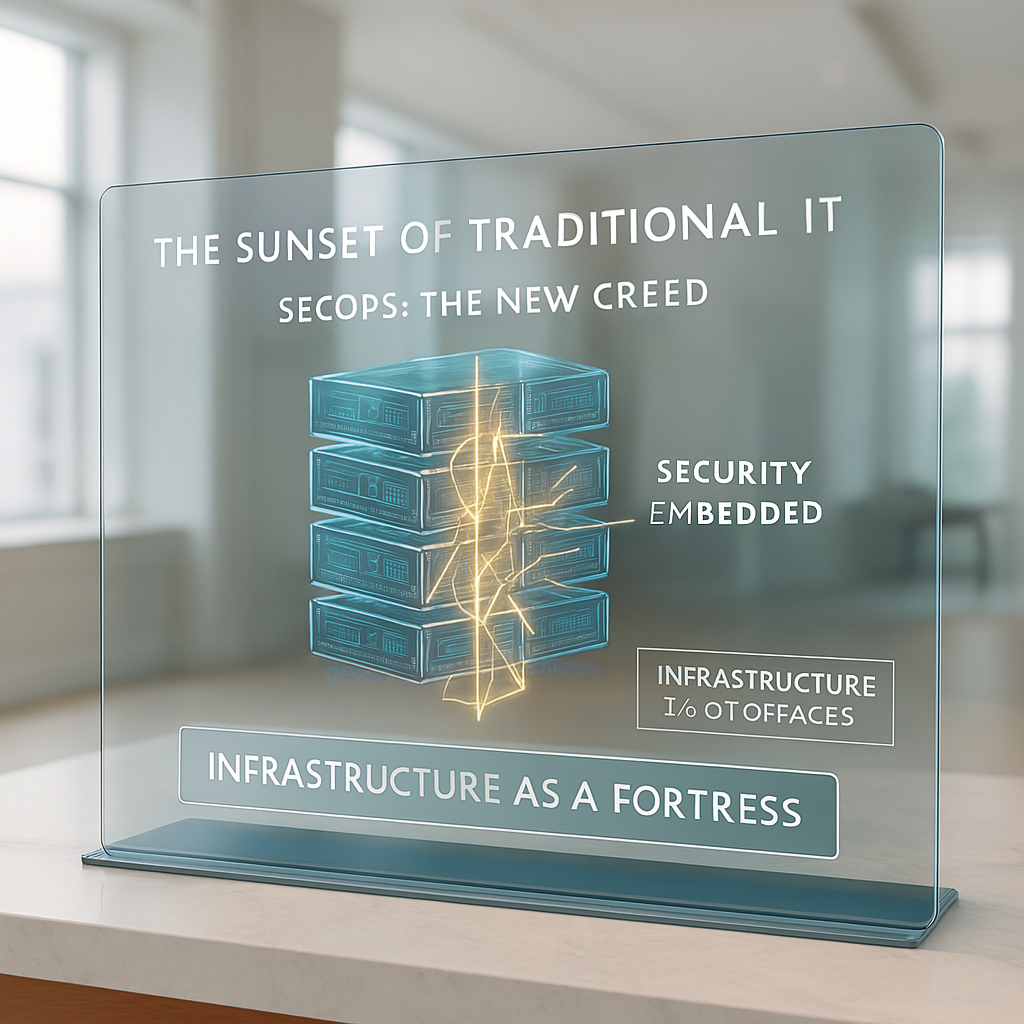
The time has come for the antiquated rules of the IT industry to be not merely questioned, but discarded entirely. We are living in an era where the demarcation line between “systems administration” and “cybersecurity” has vanished. While five years ago a systems engineer might have enjoyed the luxury of focusing solely on “keeping the servers running,” today such a stance is an open invitation to catastrophe. The reality is stark: in the modern high-tech landscape, every engineer is, by default, a security officer whether they acknowledge it or not.
The crisis we face is twofold. On one hand, there is a catastrophic talent shortage a lack of professionals capable of thinking at the intersection of infrastructure and defense. On the other, the sophistication of threats has escalated to a point where traditional defense mechanisms resemble an attempt to stop a kinetic missile with a medieval shield. We are no longer merely defending against “viruses”; we are confronting multi-layered influence operations, AI-driven ransomware, and adversaries targeting the deepest strata of infrastructure.
For decades, the archetype of the successful systems engineer was defined by uptime and user convenience. We architected environments so that everything would “just work,” often maximizing accessibility at the expense of security. In 2024, however, “convenience” without “security” has become a toxic asset. Every open session, every excessive privilege, and every simplified authentication flow is a potential attack vector that professional threat actors will exploit within hours.
During my tenure at MedaTech System Ltd, I witnessed this paradigm shift firsthand. We transitioned from the antiquated concept of a “trusted perimeter” to a Security-Led Infrastructure architecture. This represents a fundamental shift in mindset: we no longer build systems based solely on user requests; we build them based on data protection mandates. It is a rigorous process that demands continuous retraining and uncompromising discipline, yet it remains the only viable path for industrial giants whose ERP systems are woven into global supply chains.
The true tragedy of the current moment lies in the intellectual gap. The market is saturated with “administrators” who know which buttons to press in a management console, but there is a fatal scarcity of those who understand the underlying physics of an attack. A systems engineer must be a security specialist because they stand at the very origin of the architecture. Security cannot be “bolted on” as an afterthought; it must be embedded into the bedrock in the SQL Server hardening, the configuration of microwave backhaul bridges, and the logic of Just-in-Time (JIT) access orchestration.
When personnel shortages meet the increasing ingenuity of the adversary, the only way forward is through automation and predictive analytics. We have learned to build systems that do not merely react to a breach but predict it through subtle telemetry indicating network degradation. Yet, no AI can replace an engineer who understands that infrastructure stability and data integrity are two sides of the same coin.
This essay is not a market analysis; it is a deeply personal realization of responsibility. Behind every server stand real people, manufacturing plants, and supply chains that sustain thousands of families. Looking back at the journey traveled, I realize that our greatest success is not measured in the number of deployed clusters, but in the number of attacks that went unnoticed by users because the infrastructure was engineered as an impregnable fortress.
We are moving away from traditional IT toward a world where SecOps is a creed. It is a world where an engineer asks not “How do I run this?” but “How do I ensure this cannot be used against us?” It is a demanding and intellectually taxing path, yet it is infinitely vital. As I transition to the next stage of my career, I carry this fundamental wisdom: in the battle for data, victory goes not to the one with the most powerful server, but to the one who has woven security into every bit of their code.