Replacing VOIP Infrastructure
A Strategic, ROI-Driven Approach to Cost Optimization and Operational Connectivity
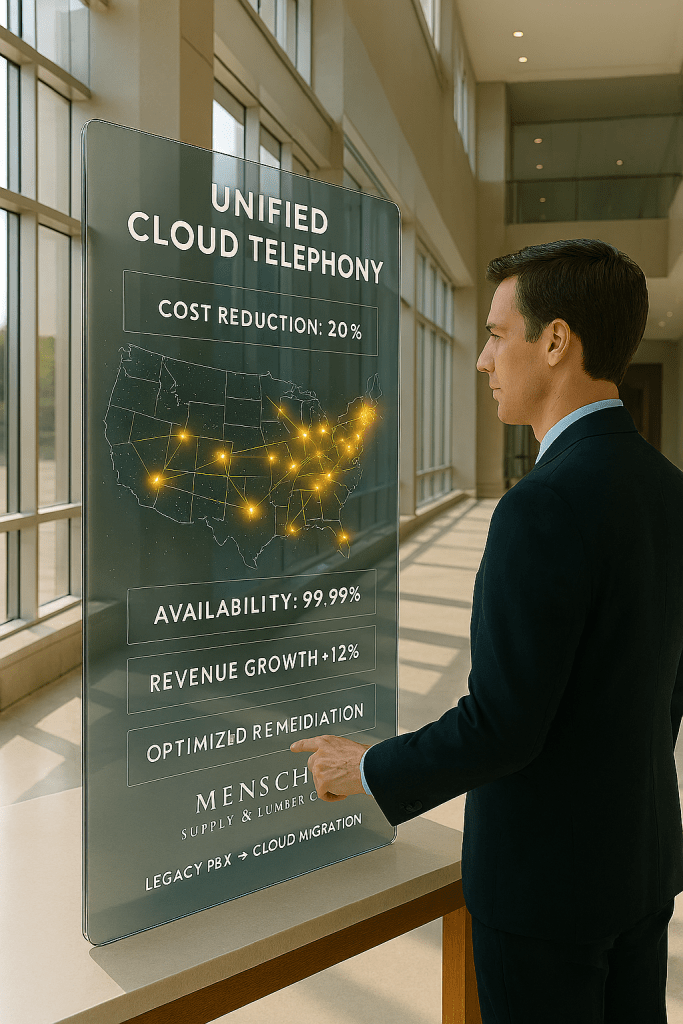
In the current cost structure of U.S. manufacturing and logistics enterprises, telecommunications maintenance is traditionally viewed as an unavoidable burden. However, by late 2025, legacy telephony has definitively transitioned from a utility service into a hidden financial barrier. The comprehensive modernization of the VoIP infrastructure at Mensch Mill Supply & Lumber Corp illustrates how migrating from fragmented legacy systems to unified cloud solutions can bridge the technological divide between branches while delivering a direct budget reduction of 20%. The primary challenge for many established American firms lies in “infrastructure debt,” where disparate analog lines and aging digital Private Branch Exchange (PBX) systems generate cascading inefficiencies. These manifest as direct maintenance costs rising 5-7% annually due to inflationary pressures, as well as significant hidden operational losses. Statistical analysis revealed that the inability to seamlessly transfer calls between remote warehouses and central offices resulted in the loss of up to 12% of inbound business inquiries a critical impact on revenue within the highly competitive building materials distribution sector.
A comprehensive technological audit confirmed that the legacy network lacked the agility required to support hybrid work models. Furthermore, hardware maintenance necessitated frequent on-site technician visits, significantly inflating the Total Cost of Ownership (TCO). Within a distributed branch environment, the absence of a unified numbering plan created an information silo between production floors and sales departments. The modernization strategy centered on a total transition from physical PBX hardware to the ModernTelephony cloud architecture, effectively shifting telecommunications from Capital Expenditure (CapEx) to a predictable Operational Expenditure (OpEx) model. A pivotal phase involved refactoring network logic by implementing Quality of Service (QoS) protocols at the Sophos backbone router level. This ensured crystal-clear voice quality even during peak data loads, when ERP systems and high-definition surveillance traffic typically saturate available bandwidth.
The turnkey project involved replacing over 200 endpoints with modern IP hardware and deploying softphones for mobile employees and field sales representatives. A critical analytical component was the integration of the VoIP ecosystem with SAP and Spruce ERP platforms, enabling “Click-to-Call” functionality and automated customer identification. This integration reduced average order processing time by 18%, while high-compression, lossless codecs minimized inter-office bandwidth consumption while maintaining 99.99% service availability. The 20% direct budget reduction achieved by December 2025 resulted from the elimination of inter-branch toll charges and the centralization of management. A single administrator can now oversee corporate directories and routing rules for all sites via a centralized dashboard, saving up to 15 man-hours per week previously dedicated to manual, on-site equipment configuration.
The most significant impact was observed in the surge of operational agility: the system allowed for the instantaneous scaling of workstations without the need for new physical lines, reducing communication deployment time for new hires from three days to ten minutes. In the U.S. market, where response velocity is a vital competitive advantage, this transformation has become a powerful driver of growth. By late 2025, the American industrial standard has solidified: modern telephony is no longer merely about voice transmission, but about deep data integration. The Mensch Mill Supply case confirms that professional project management in infrastructure modernization can resolve chronic communication bottlenecks and provide a foundation for long-term financial optimization. We have demonstrated that with a strategic engineering approach, IT infrastructure evolves from a cost center into an efficient business tool, directly enhancing the profitability and resilience of the enterprise in a shifting economy.
December 2025
Senior Systems & Infrastructure Engineer, Mensch Mill Supply & Lumber Corp
Dmitry Bogoliubov