Zero-Downtime Migration
A Seamless Strategy for Moving Critical Workloads from Rackspace to AWS
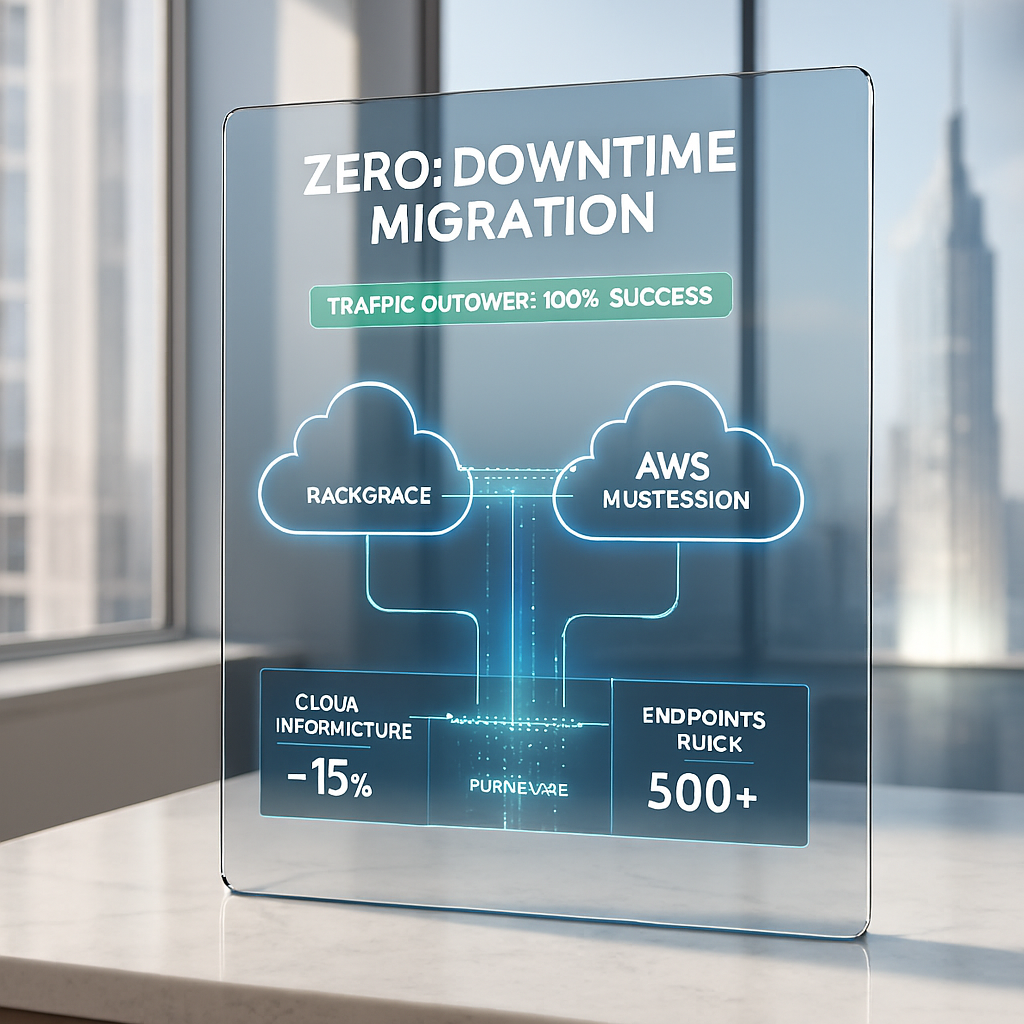
In the modern IT landscape, migrating a large-scale infrastructure is often likened to rebuilding the foundation of a fully occupied skyscraper. The EnSight+ case study, involving an ecosystem that supports over 500 active endpoints and mission-critical business services, serves as a premier example of executing such a transition under the “Zero Downtime” principle. In the hyper-competitive U.S. market, where the cost of downtime is measured in thousands of dollars per minute, any service interruption is viewed as a critical risk to operational continuity and corporate reputation. A deep analysis of similar projects reveals that the primary cause of failure is the underestimation of network latency and the inevitable session drops during traffic cutover. In this project, the situation was further complicated by a distributed device architecture requiring continuous, low-latency data exchange with central databases. To neutralize these risks, a hybrid network architecture was engineered, establishing a unified L3 space between Rackspace and AWS regions via Multi-region Site-to-Site VPN. This enabled new instances to interact with legacy infrastructure within a single local network, effectively eliminating jitter and preventing data corruption during the synchronization phase.
Rather than a staged migration of individual services, a “parallel-run” methodology was applied. Leveraging Infrastructure as Code (Terraform) ensured the deployment of identical environments in AWS with guaranteed configuration parity, eliminating the risk of configuration drift or errors stemming from disparate OS settings and library versions. To maintain real-time data integrity, a Change Data Capture (CDC) scheme was implemented. While the primary transaction flow was initially processed by Rackspace, every update was mirrored to the AWS cloud with millisecond latency. This approach kept both environments in an identical state, entirely eliminating the risk of data loss at the moment of the final switch. It is crucial to note that with over 500 active endpoints, even a minor discrepancy in database state would have triggered a cascading failure of client applications a scenario averted through precision-tuned streaming replication.
The technical cutover the most critical phase was executed using progressive routing management mechanisms. To prevent a mass disconnect of hundreds of terminals due to DNS caching at the ISP or client hardware levels, we utilized AWS Route 53 with Weighted Routing capabilities. The process began by redirecting only 5% of requests to verify stability within the “live” AWS environment. Only after confirming optimal latency and the absence of errors in the logs was the traffic share systematically increased: to 20%, 50%, and finally, the full 100%. For end-users, this transition remained completely transparent, despite the scale of the technological leap between providers. This strategy allowed engineers to monitor the load on new nodes and refine Application Load Balancer (ALB) configurations in real-time without service interruption.
The result of this strategy was not only the achievement of Zero Downtime but also a qualitative optimization of the company’s entire IT landscape. The migration to AWS facilitated the implementation of full multi-regional resilience and reduced cloud expenditures by 15% through precision right-sizing and the use of Auto Scaling groups. This case study reaffirms a dominant market trend: the value of systems engineering today is measured by the ability to guarantee Business Continuity. Infrastructure must remain invisible, ensuring flawless operation even while its technological foundation is being completely replaced. Ultimately, the success of this project in January 2025 laid the groundwork for further DevSecOps integration at EnSight+, transforming IT from a support function into a powerful growth driver in the American market.