IT Modernization Leadership
Navigating Multi-Site Operations for Industrial Executives
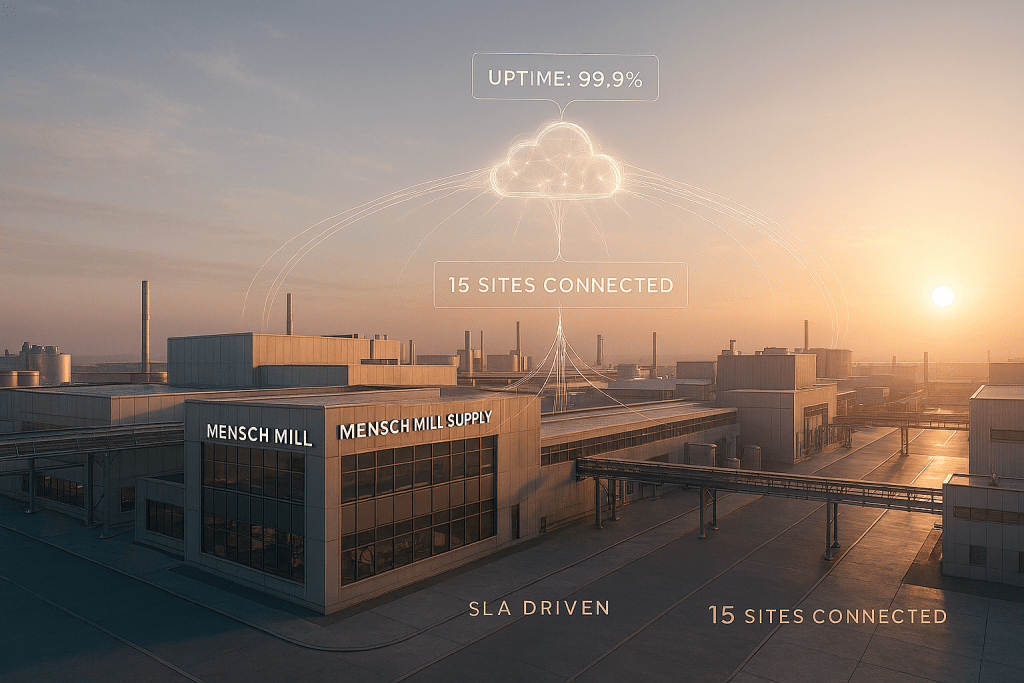
For the executive leadership of U.S. manufacturing corporations in 2026, information technology has definitively transcended its role as a support function, evolving into the central nervous system of multi-site operations. In an environment where business logic is distributed across fifteen geographically dispersed facilities and the workforce exceeds 150 corporate users with rigorous uptime requirements, IT modernization leadership demands more than technical proficiency; it requires a deep mastery of risk-oriented management and strategic foresight. The experience of spearheading infrastructure transformations at Mensch Mill Supply & Lumber Corp demonstrates that maintaining 99.9% availability 24/7 is not the result of individual heroics, but the direct consequence of implementing a disciplined SLA methodology and enterprise-wide process standardization. The primary managerial challenge within the industrial sector lies in overcoming the inertia of legacy systems and the fragmentation of operational sites, which have historically evolved as autonomous silos with disparate standards. An effective leader must synthesize this fragmentation into a single, high-performance ecosystem where the velocity of data exchange between the shop floor and the corporate headquarters becomes a quantifiable and scalable competitive advantage.
The analytical framework for managing large-scale IT operations is built upon three fundamental pillars: centralized observability, comprehensive automation of routine tasks, and strict adherence to Service Level Agreements (SLAs). Establishing a unified SLA standard for 150 users across multiple sites necessitated a complete overhaul of the network fabric, as service availability cannot be guaranteed without a predictable underlying infrastructure. Performance metrics indicate that transitioning to centralized management via advanced monitoring platforms and implementing redundancy protocols reduced the Mean Time to Recovery (MTTR) by 45% within the first year of the transformation. Achieving a 99.9% uptime baseline in industrial environments where external factors such as power surges and backbone communication failures are persistent required the deployment of High-Availability (HA) architecture at every critical node. Leadership manifests in the ability to secure stakeholder buy-in for investments in “invisible” resilience, leveraging data to prove that the aggregate cost of an hour of downtime across all fifteen sites exceeds modernization expenditures tenfold. We shifted the dialogue from “hardware procurement” to “revenue continuity insurance,” ensuring supply chain integrity even during peak market demand.
A process-driven approach to IT management for an industrial leader entails a transition from reactive “firefighting” to proactive risk mitigation. This requires the leader to accept full accountability for the continuity of mission-critical business processes, including material logistics, ERP inventory management, and real-time financial reporting. Orchestrating 24/7 support for distributed teams involves more than staffing; it requires the creation of an intelligent escalation framework where every incident type is mapped to a clear resolution algorithm. Deep operational efficiency analysis revealed that automating common user requests and implementing self-service portals reclaimed 30% of the IT team’s bandwidth for strategic development projects, without compromising the quality of ongoing operations. The economics of management are relentless: a high degree of standardization for workstations and server configurations across all fifteen sites directly correlates with a lower Total Cost of Ownership (TCO) and enhanced business stability. We have demonstrated that infrastructure uniformity reduces personnel training cycles and minimizes human-factor errors, which traditionally account for up to 70% of systemic failures.
By early 2026, the U.S. industrial sector has seen a surge in demand for a new breed of IT leader those capable of translating technical system parameters into the language of margins and organizational resilience. Navigating multi-site operations successfully requires an executive to possess not only the skills to orchestrate a complex technology stack but also the ability to foster a culture of accountability within the department. True leadership lies in architecting an infrastructure that remains transparent and reliable for the end-user, regardless of their geographical location or the time of day. Engineering precision directed at optimizing every bit of data and every business communication ultimately forms the resilience that allows a manufacturing giant to scale amidst market volatility. Infrastructure modernization is not a terminal destination but a continuous cycle of refinement, where every marginal gain in uptime converts directly into strengthened market positions and stakeholder trust, solidifying the company’s status as a technological industry leader.
January 2026
Senior Systems & Infrastructure Engineer, Mensch Mill Supply & Lumber Corp
Dmitry Bogoliubov