Supply Chain Resilience
Modernizing ERP Infrastructure for High-Volume Operations
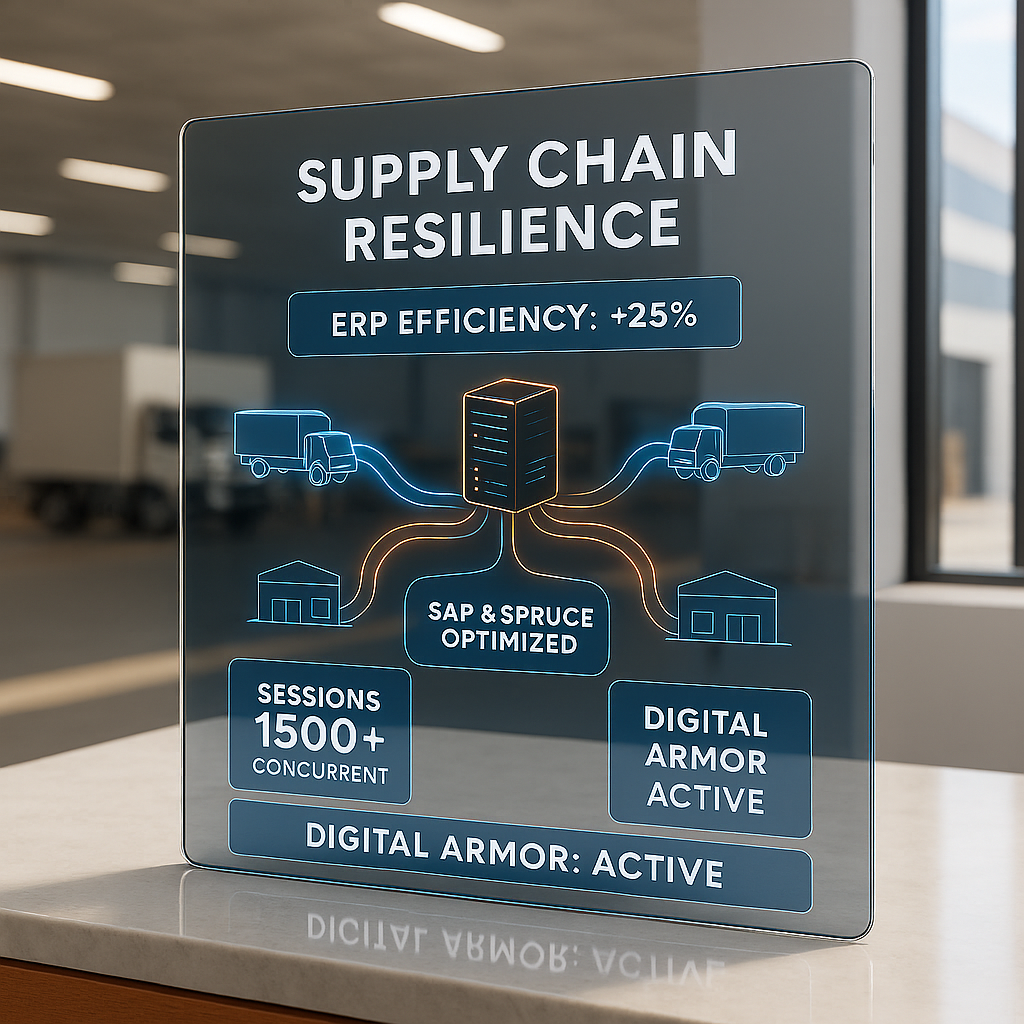
In modern industrial logistics, business efficacy is no longer determined solely by product quality or warehousing capacity; today, it is directly dictated by the velocity and integrity of data moving through the digital arteries of the IT infrastructure. For enterprises relying on heavyweight ERP ecosystems such as SAP or Spruce, legacy infrastructure frequently becomes a critical bottleneck. Archaic network protocols and physically depreciated hardware create invisible yet formidable barriers that decelerate shipment rates and disrupt the rhythm of global supply chains. In an environment of dynamic scaling where order volumes exponentially exceed initial design capacities any micro-latency in data transmission from a remote warehouse terminal to the central database scales into tangible equipment downtime and breached contractual obligations. My experience as a Cybersecurity Infrastructure Manager confirms that many C-suite executives still tend to perceive IT as a secondary cost center, overlooking the reality that in 2026, infrastructure serves as the primary accelerator of the operational cycle.
The foundation for profound transformation in these projects lies in transitioning from fragmented, often chaotic network topologies to a precision-engineered environment secured by advanced solutions like Sophos. We operate on the proven postulate that the stability of mission-critical systems like SAP or Spruce is over 40% dependent on the integrity and throughput of the underlying network fabric. Implementing next-generation secure connectivity and high-performance switching allowed us to completely mitigate the micro-lags and packet loss that previously triggered transaction “hangs” during extreme peak loads. This is critical in environments where over 1,500 concurrent users generate continuous database queries. In such a configuration, even minor jitter within the local or wide-area network causes cascading lock escalation at the SQL engine level, paralyzing entire departments. Modernizing the network landscape enabled us to achieve more than just system stability; we realized a linear performance gain, with transaction processing speeds increasing by 25%. This immediately correlated with key business metrics: the time required for shipping documentation and the physical dispatch of transport from logistics hubs was reduced in direct proportion to the IT system’s acceleration.
The central node of this new architecture was the deep integration of Sophos security gateways, which, in our strategy, evolved from mere perimeter barriers into intelligent traffic orchestration tools. We implemented Deep Packet Inspection (DPI) and Layer 7 Quality of Service (QoS) prioritization specifically for ERP traffic. This guaranteed the absolute stability of Spruce operations, even during periods of maximum external link utilization or background system updates. This configuration allowed us to completely neutralize scenarios where scheduled heavy analytical reporting or external cyber threats could destabilize warehouse terminals. In this paradigm, ERP stability is no longer a technical parameter it is a fundamental business metric. Minimizing interface latency directly correlates with a reduction in vehicle dwell time at loading zones. For a large-scale enterprise, this translates into saving hundreds of engine hours monthly and preventing operational losses totaling thousands of dollars.
Ultimately, this comprehensive infrastructure modernization convincingly demonstrated that IT is not a support function, but a strategic asset and the primary driver of business growth. We created an ecosystem where the technological foundation does not merely “support” SAP it actively stimulates the throughput of the entire supply chain. The hallmark of a modern Cybersecurity Infrastructure Manager is the ability to look past the Sophos or CrowdStrike configuration consoles to see actual shipment schedules, clearly understanding how every bit of transmitted data impacts the company’s overall valuation. Upon project completion, we recorded a sustained 25% increase in operational efficiency, proving that architectural proactivity transforms the IT department into a profit management center. In an era of total global competition, the strategic advantage belongs to those who view their infrastructure as “digital armor,” ensuring flawless business continuity under any degree of external pressure or market volatility.
March 2025
Dmitry Bogoliubov