Security at Mach Speed
Safeguarding Infrastructure During Startup Hyper-Growth
In the high-stakes world of hyper-growth startups, there exists a definitive point of no return where the sheer scale of the business begins to dictate technical requirements. One day, you are a lean group of scientists in a laboratory; the next, StoreDot is securing hundreds of millions in investment, and you are mandated to onboard dozens of high-caliber engineers every week. For a systems architect, this is the moment of truth: you either maintain the pace of the business or watch your infrastructure incinerate under the staggering weight of technical debt and security breaches. In 2021, I found myself at the epicenter of this storm, a time when traditional administration methodologies became obsolete within the first month of rapid expansion.
The fundamental challenge of any operational “liftoff” is the rapid erosion of control. The business demands fully functional workstations “yesterday.” If a systems engineer spends two days manually provisioning each laptop, installing specialized software, and defining access policies, they become the primary bottleneck to productivity. Yet, there is a dangerous flip side: in the rush to scale, administrators often succumb to the temptation of granting local administrative rights indiscriminately, neglecting Multi-Factor Authentication (MFA), or bypassing network segmentation protocols for the sake of convenience. For a company on the trajectory toward an IPO or significant funding rounds, this chaos is a death sentence. Any rigorous security audit will expose these systemic failures, and the company’s valuation will plummet before it even hits the trading floor, as investors are acutely sensitive to risks involving intellectual property compromise.
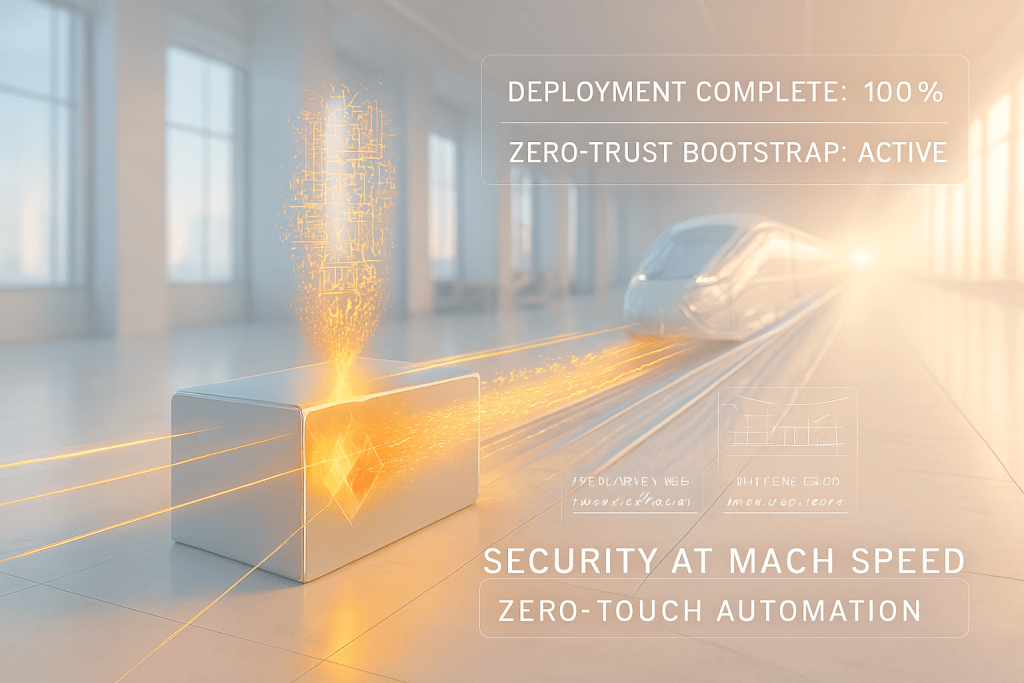
Collaborating with StoreDot as part of the MedaTech System Ltd team, I realized that the only way to survive this acceleration was to completely excise the human factor from the deployment lifecycle. We executed a radical pivot toward the concept of Infrastructure as Code (IaC), transforming environment configuration into an executable algorithm. I established a non-negotiable objective: provisioning a new, fully compliant, and hardened workstation must take no longer than the time required to drink a cup of coffee. We automated every phase. Configuration management scripts deployed the operating system, immediately bootstrapped SentinelOne agents for endpoint protection, installed requisite security certificates, and enforced granular access rights based strictly on the employee’s role. There was no longer room for improvisation or the hazardous “just disable the antivirus for a second” requests.
This framework empowered us to scale in real-time, synchronizing perfectly with the HR department’s velocity. While a new physicist or engineer was signing their contract, the system was already architecting their digital environment, including access to requisite compute clusters and cloud resources. Security ceased to be a bottleneck; instead, it became the invisible rails that allowed the company to surge forward. We implemented Zero Touch Provisioning, where hardware could be delivered to an employee in its factory packaging, and configuration would commence automatically upon the first power-on. This enabled us to sustain growth rates five times faster than the market average without inflating our IT headcount or compromising our security posture.
By 2022, we provided empirical proof that even amidst the most aggressive growth, an infrastructure can remain an impregnable fortress. My primary takeaway from this experience is that architecture for a scaling startup is not a question of hardware procurement, but a refinement of algorithms. If you cannot automate your defense, you will inevitably lose it under the pressure of operational routine. We created an environment where security is woven into the very fabric of value creation, ensuring the company’s technological sovereignty on its path to global leadership in the energy sector. In the era of hyper-growth, victory belongs not to those who work harder, but to those who transform complex processes into flawless, repeatable code.