Data Integrity in High-Concurrency Environments
Architectural Resilience for Global Supply Chains
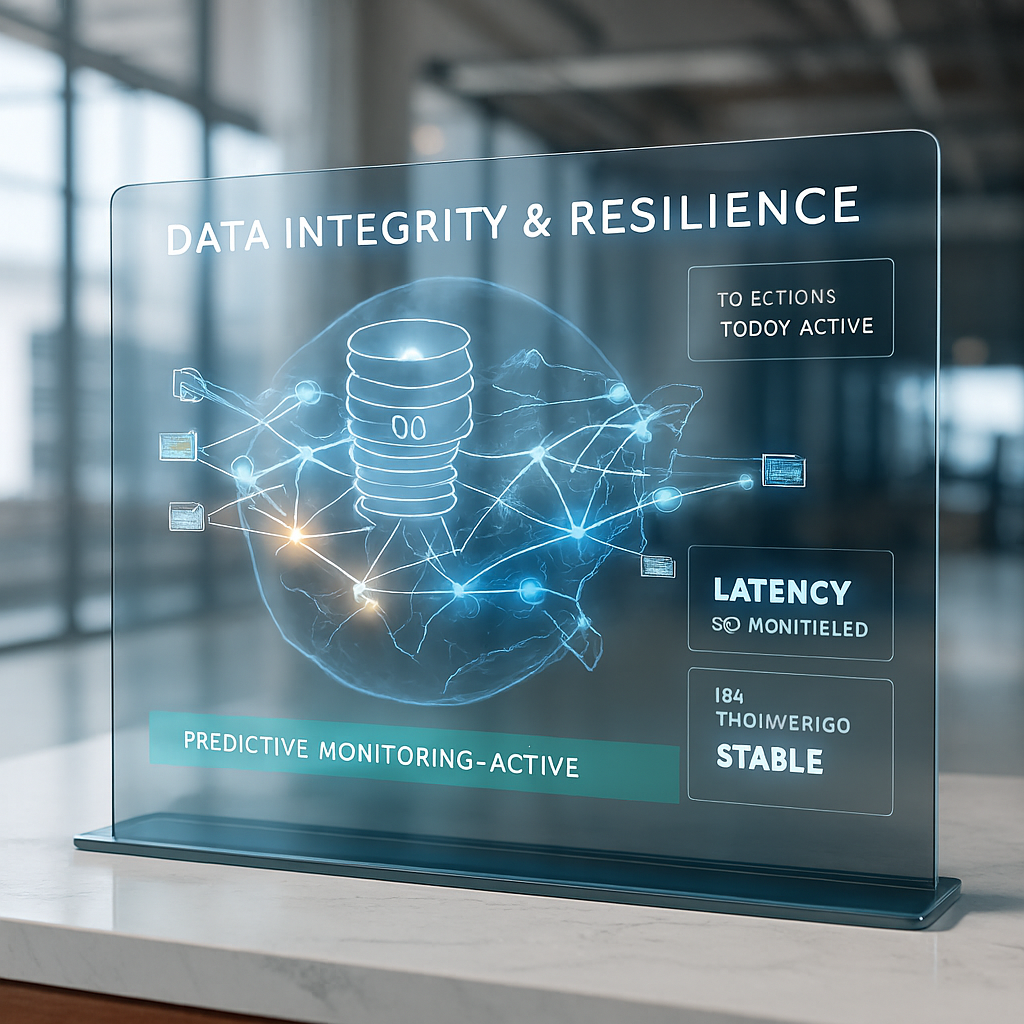
In the modern global economy, a database is no longer a mere repository; it has evolved into the foundational infrastructure upon which all operational logistics are constructed. For leading industrial enterprises whose business processes are deeply integrated into international supply chains, any performance degradation within the Priority ERP system scales instantaneously into direct financial losses. When an infrastructure serves over 1,500 concurrent active sessions in real-time, the cost of a single architectural oversight or an unoptimized “heavy” query escalates to the level of enterprise-scale risk. In such environments, the database functions as a living organism whose “heartbeat” directly dictates the operational viability of ports, automated fulfillment centers, and continuous production lines. The primary challenge of high-load environments lies in the accumulation of “silent” degradation: table locks, index fragmentation, and inefficient execution plans create a cumulative bottleneck effect that cannot be mitigated by simple horizontal or vertical hardware scaling.
During peak hours, when thousands of warehouse terminals concurrently request inventory updates, microscopic latencies at the SQL engine level cascade into critical spikes in response times. For a major logistics hub, this results in instantaneous paralysis: halted conveyor systems, idling transport fleets, and violated contractual obligations to global partners. My experience at MedaTech System Ltd has demonstrated that classical reactive administration addressing “fires” post-incident is economically unsustainable. Restoring a system after a failure is an admission of defeat, locking in multi-million dollar losses. Ensuring the stability of such a complex ecosystem required a radical overhaul of the entire architectural paradigm. We pivoted from passive maintenance to a model of total proactivity and the enforcement of transactional determinism. This began with a deep audit of the internal logic governing MS SQL Server interactions, operating on the postulate that standard maintenance plans are incapable of accounting for the real-time dynamics of Priority ERP under extreme workloads.
As a result, we engineered and deployed proprietary adaptive dynamic reindexing algorithms. Unlike generic solutions, our scripts perform stream analysis of fragmentation levels and current I/O subsystem pressure, initiating maintenance only for objects that represent potential failure points. This allowed us to synchronize maintenance tasks with actual production windows. We achieved a significant reduction in Resource Waits and almost entirely eliminated Deadlocks, even during periods of peak user activity. Particular emphasis was placed on reducing Latch contention, enabling the system to demonstrate linear scalability as transaction volumes increased. The cornerstone of this new architecture was a predictive monitoring system providing continuous oversight of over 50 critical performance parameters. We shifted the focus from trivial metrics, such as CPU or RAM utilization, to a deep analysis of the SQL core: Page Life Expectancy, Buffer Cache Hit Ratio, and specific Wait Statistics.
Fine-tuning automated alerts for threshold values enabled the engineering team to identify emerging bottlenecks 15–20 minutes before an end-user at a logistics center would experience interface latency. This “window of opportunity” became a decisive factor, allowing for preemptive resource allocation and on-the-fly I/O optimization without interrupting mission-critical business processes. The implemented automated analysis of “expensive” queries detects inefficient code in the plan cache upon its first appearance, allowing for remediation before the load becomes catastrophic. Consequently, the IT team transitioned from an emergency response unit to “air traffic controllers,” managing data flows with surgical precision. The efficacy of this strategy is validated by objective statistics over the last two years of operation. We achieved a 45% reduction in critical database incidents, and the transition to proactive maintenance eliminated nearly half of all performance-related system failures. Direct optimization of I/O procedures and execution plans reduced average latency by 30% across all key logistics hubs.
However, the most vital result of this transformation was the radical minimization of financial losses due to downtime. In an industry where every hour of uptime correlates directly with profitability, we proved that investments in deep technical expertise and architectural proactivity yield exponential returns. For the industrial sector, operating amidst constant external challenges, IT infrastructure stability is not merely a technical parameter it is a strategic insurance policy ensuring sustainable growth and the fulfillment of global market obligations. We have built a digital ecosystem that does not just store data, but actively sustains business continuity, transforming technological complexity into a sustainable competitive advantage.