Supply Chain Resilience
Why Network Modernization is the Real Cure for Industrial ERP Latency
In the U.S. building materials distribution sector, a systemic challenge persists that many industry leaders choose to overlook, while front offices aggressively adopt cloud-native CRMs and AI-driven analytics, back offices and warehouses often continue to operate on decade-old infrastructure. When enterprises like Mensch Mill Supply & Lumber Corp enter a phase of rapid scaling, it is rarely the sales force that falters first it is the network foundation. Legacy cabling, overloaded switches, and antiquated firewalls create an “infrastructure thrombus” that chokes even the most robust ERP systems, such as SAP or Spruce. The “bottleneck” phenomenon in industrial IT is seldom a software issue; more often, it is rooted in the physical degradation of the OSI layers. Inconsistent ERP access at production sites means warehouse terminals lose database connectivity precisely during peak shipping hours. In the U.S. market, where “Just-in-Time” logistics is the gold standard, a mere fifteen-minute delay in inventory synchronization can trigger a cascading failure of delivery schedules across an entire region. Resolving this requires more than superficial “patching”; it demands a comprehensive refactoring of both the physical and logical environments.
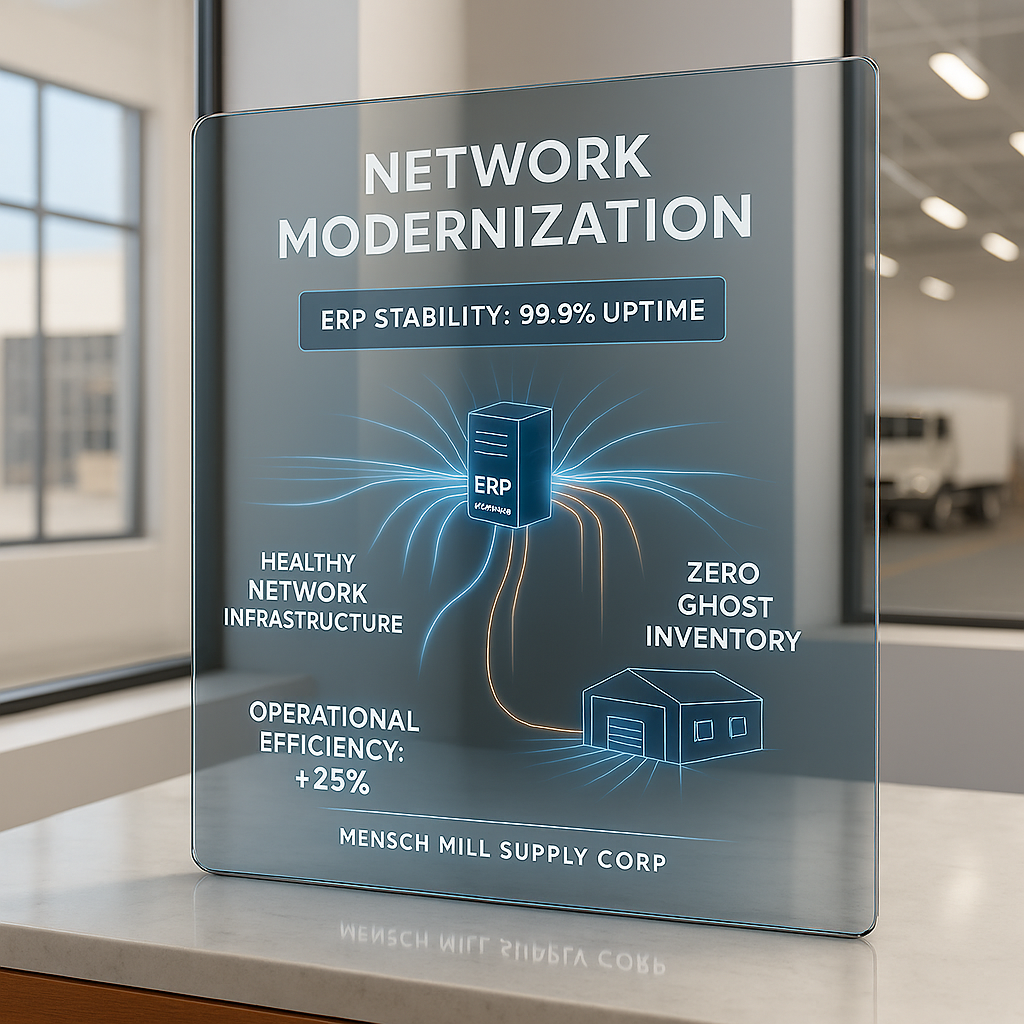
Evidence from modernizing such facilities demonstrates that the primary driver of transformation is a complete overhaul of cabling systems coupled with the implementation of tiered, defense-in-depth perimeter security, such as Sophos solutions. Establishing a clean, segmented network environment is the only way to allow an ERP system to reach its full operational potential. Once backbone bandwidth is no longer a limiting factor, metrics like 99.9% uptime transition from being an elusive target to becoming the baseline state of the environment. This ensures real-time synchronization between remote warehouses and the corporate headquarters, effectively eliminating the risk of “ghost inventory” stock that appears available in the system but is physically absent from the shelves due to transactional lag. In an industrial setting, every second of server latency is not merely an employee inconvenience; it is a direct hit to warehouse throughput that translates into significant financial losses over a monthly cycle.
Hardware modernization frequently serves as a catalyst for qualitative improvements in adjacent business functions. Transitioning from legacy analog telephony to modern VoIP systems in an industrial environment offers more than just a 20% reduction in communication overhead. It facilitates the integration of communications into the broader digital data flow. When a shop floor foreman and a corporate manager operate within a unified information space, the velocity of decision-making increases exponentially. In this context, IT infrastructure ceases to be a “cost center” and evolves into a strategic business accelerator. Automated workflows built upon a resilient network foundation can boost operational efficiency by up to 25% without requiring additional headcount. This is achieved by eliminating data entry micro-errors and the need for redundant verification caused by system instability. Modern engineering expertise lies in recognizing the direct correlation between the quality of a cable termination and the margin reported in a quarterly financial statement.
By mid-2025, a new standard has firmly established itself in the industrial sector: ERP stability is a direct derivative of network engineering quality. The success of a modern distributor depends not on raw server horsepower, but on how seamlessly the infrastructure is synchronized with the rhythm of logistics and shipping. Engineering expertise in the United States is shifting toward a systemic approach, where every cable run and every firewall configuration is viewed as a direct investment in the throughput of the entire supply chain. Only this synergy allows fragmented warehouses to be transformed into a single, flawlessly functioning mechanism protected by digital armor and fully prepared for the challenges of tomorrow.