Vulnerability Remediation
Beyond Scanning – A Strategic Approach to Risk Reduction
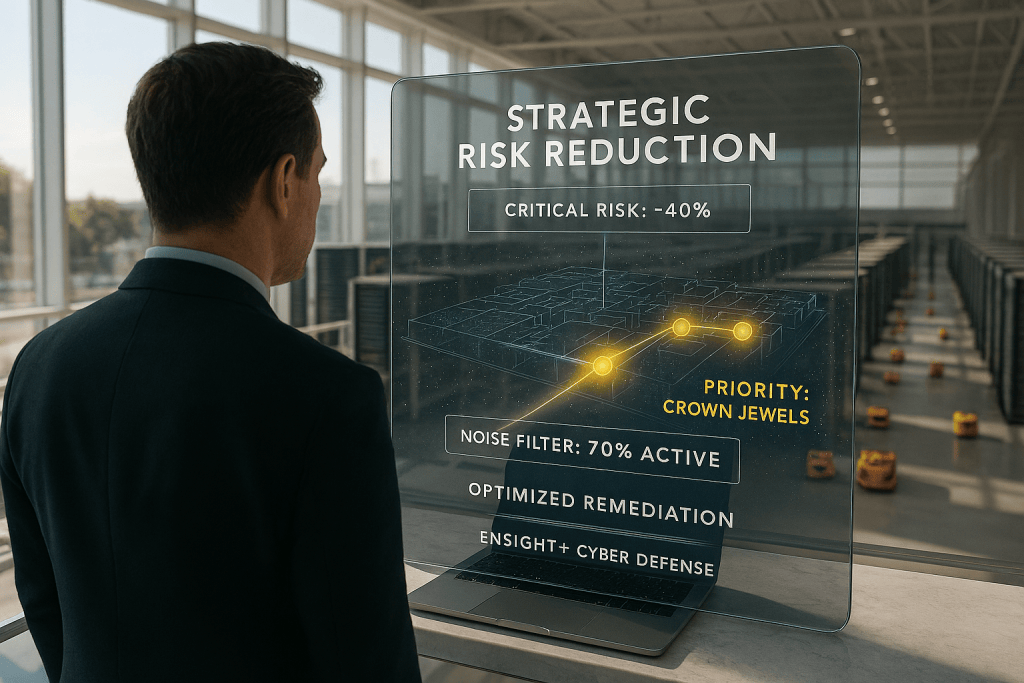
For modern American enterprises, cybersecurity has long evolved beyond mere software ownership and into the realm of operational risk management. One of the most pervasive challenges in the Enterprise segment remains “alert fatigue”, security departments are frequently overwhelmed by thousands of vulnerability scanner reports that produce exhaustive lists of technical flaws without providing business context. The transformation of processes at EnSight+ demonstrates that the key to achieving a 40% reduction in actual risk within just six months lies not in increasing scanning frequency, but in adopting a strategic prioritization methodology known as the Vulnerability Management Lifecycle. We recognized that the indiscriminate “patching by the list” is an unsustainable approach that consumes vast resources while offering minimal impact on the organization’s factual security posture.
The traditional approach to remediation, based solely on CVSS scores, is increasingly recognized as ineffective in 2026. A high CVSS score, in isolation, fails to account for a system’s exposure or the existence of weaponized exploits in the wild (Exploit Prediction Scoring System EPSS). Strategic risk management demands a shift in perspective: a patch for a single DMZ-facing server with access to customer databases is exponentially more critical than ten updates on isolated workstations, even if the latter carry a higher nominal threat rating. This contextual prioritization allows teams to focus limited resources on protecting “crown jewels,” neutralizing attack vectors that could lead to catastrophic business consequences. We implemented a weighted scoring system that integrates technical telemetry with asset criticality, enabling us to filter out up to 70% of the “noise” and concentrate exclusively on the core infrastructure.
Achieving a 40% reduction in critical risk over a six-month period was facilitated by implementing a remediation cycle deeply integrated into IT operations. Rather than offloading responsibility to system administrators through massive, unmanageable PDF reports, we established a process for classifying assets by their impact on business continuity. In this model, a vulnerability is classified not only by its technical complexity but by its potential for damage. If a security flaw theoretically facilitates lateral movement toward financial systems or intellectual property repositories, its remediation becomes the top priority, overriding all scheduled maintenance tasks. We fostered an environment where IT and Security teams operate in lockstep, understanding that the velocity of closing the “vulnerability window” on critical nodes is the primary KPI of their collaborative effort.
By November 2025, a clear standard has firmly established itself within the U.S. cybersecurity community: Vulnerability Remediation is not mere technical hygiene, but a critical tool for managing corporate valuation. An engineer’s ability to suppress scanner noise and focus on critical infrastructure nodes is a hallmark of architectural maturity. Effective cybersecurity today lies in the ability to think in terms of risk management, transforming a chaotic stream of threat data into a transparent and economically justified enterprise defense strategy. This procedural transparency allowed us to not only elevate our defensive posture but also to demonstrate the ROI of security investments to executive leadership by showcasing the tangible decline in attack probability. Ultimately, victory in this technological race belongs to those who can distinguish theoretical threats from practical risks and act preemptively where a breach would be most fatal to the company’s reputation and finances.
November 2025
Cybersecurity Infrastructure Manager, EnSight+
Dmitry Bogoliubov