The Hybrid Cloud Dilemma
Securing 1,500+ Users Across a Converged Azure and AWS Ecosystem
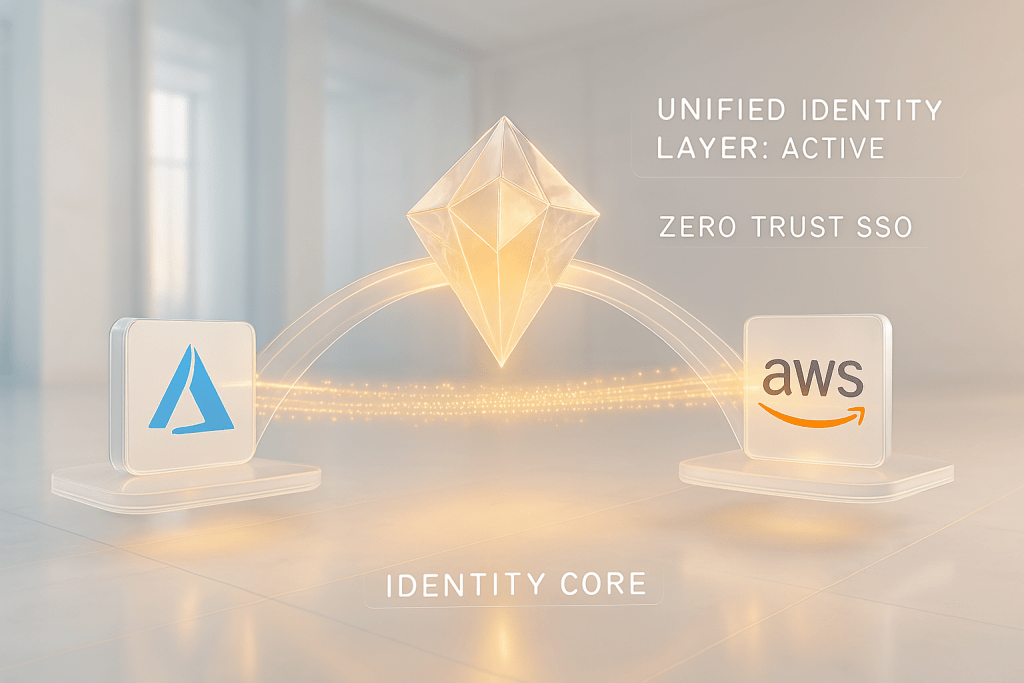
When an infrastructure scales to accommodate over 1,500 active users distributed across Microsoft Azure and AWS, an organization inevitably confronts its most formidable adversary: fragmentation. By 2022, at MedaTech System Ltd, this challenge had evolved from a technical hurdle into a strategic imperative. The divergence of security policies at the intersection of two disparate cloud service providers represents a critical vulnerability one that enterprises often overlook until the first major security incident occurs. The core issue within hybrid environments lies in the illusion of control; while each provider offers a proprietary security stack, an administrative “no-man’s-land” emerges where Azure and AWS converge. Disparate authentication protocols, inconsistent access policies, and redundant user identities create ideal attack vectors while simultaneously crippling workforce productivity.
Industry metrics indicate that due to data fragmentation, IT departments often expend up to 70% of their operational cycles on manual access synchronization and resolving security conflicts, rather than focusing on proactive infrastructure development. We encountered a scenario where access management had devolved into an endless loop of reactive troubleshooting, where a misconfiguration in one segment could remain undetected for months while being exploited in another. To mitigate this risk, I spearheaded the implementation of a Unified Identity Layer. We moved away from siloed methodologies in favor of centralized authentication, aiming to dissolve boundaries for the end-user while intensifying granular control for administrators.
The linchpin of this solution was the deep integration of Azure AD (now Microsoft Entra ID) as the authoritative “Source of Truth” for all enterprise resources, including AWS instances. We implemented Single Sign-On (SSO) bolstered by rigorous Conditional Access policies. The system evolved beyond traditional password prompts to analyze real-time context entry points, device health, and risk scores before granting access to data in either cloud environment. By integrating identity federation via the SAML 2.0 protocol, we enabled AWS to “trust” identity tokens issued by Azure. This eliminated the need for static IAM credentials for each user within AWS, radically reducing the risk of credential theft and secret leakage.
The results of this optimization were both pragmatic and quantifiable. We did not merely close security loopholes; we directly enhanced organizational velocity. By eliminating redundant credential prompts and optimizing authentication routing, we achieved a 30% reduction in login latency. Fifteen hundred users gained seamless, frictionless access to their essential toolsets, significantly improving overall employee experience. Furthermore, we achieved a “single pane of glass” management capability; any user account can now be revoked or modified across the entire hybrid fabric with a single click a capability that is mission-critical during offboarding or in the event of detected anomalous activity.
Beyond security, centralization provided unprecedented cost transparency. We gained the ability to monitor actual resource consumption in real-time and eliminate “shadow” accounts that had been silently draining AWS budgets for years. My experience demonstrates that in a hybrid world, security must be monolithic. If your cloud environments do not “communicate” through a unified security language, you are not managing an infrastructure you are merely watching it become unmanageable. We engineered a system where technology serves not as a barrier, but as a catalyst, allowing the business to scale regardless of the constraints of a specific cloud platform.