SentinelOne on the Front Lines
Surviving the 2021–2023 Cyber Warfare
In Israel, cyberspace is not a virtual sandbox; it is a visceral battlefield where operational errors cost more than just data they jeopardize the viability of entire industries. Between 2021 and 2023, Israeli Managed Service Providers (MSPs) found themselves at the epicenter of a sustained kinetic storm. These were not random malware outbreaks or trivial phishing campaigns; we faced methodical, state-sponsored, or highly organized operations designed to dismantle the infrastructure underpinning the national economy. For me, as a Senior Systems Engineer at MedaTech System Ltd, this period was a professional crucible. I witnessed enterprises built over decades dissolve in an instant due to a single missed second or a misconfigured firewall rule.
The defining threat of that era was the Supply Chain Attack targeting MSPs. Threat actors struck us to obtain the keys to hundreds of client networks a sinister “domino effect” where one compromised administrative credential could paralyze dozens of manufacturing plants and logistics centers simultaneously. In this climate, legacy signature-based antivirus solutions were futile; they merely performed a “post-mortem” on the system after the data had already been exfiltrated and encrypted. Our response was a strategic pivot to the SentinelOne platform and the deep integration of Endpoint Detection and Response (EDR) mechanics into the very DNA of our clients’ infrastructure. However, it is critical to understand that “out-of-the-box” solutions do not save companies precision engineering and a profound understanding of adversary logic do.
To forge a truly adaptive digital shield, I focused on three architectural imperatives. The first step was a total transition to Behavioral AI over static signatures. We implemented policies that scrutinized “actions” rather than “files.” In an environment where attackers utilize “Living off the Land” (LotL) techniques using legitimate system tools to mask their presence a file may appear benign while its behavior reveals malicious intent. If a PowerShell script suddenly attempted to access Volume Shadow Copies (VSS) for deletion or initiated bulk file renaming, SentinelOne terminated the process instantaneously. This allowed us to neutralize zero-day threats that had not yet been cataloged in any global database.
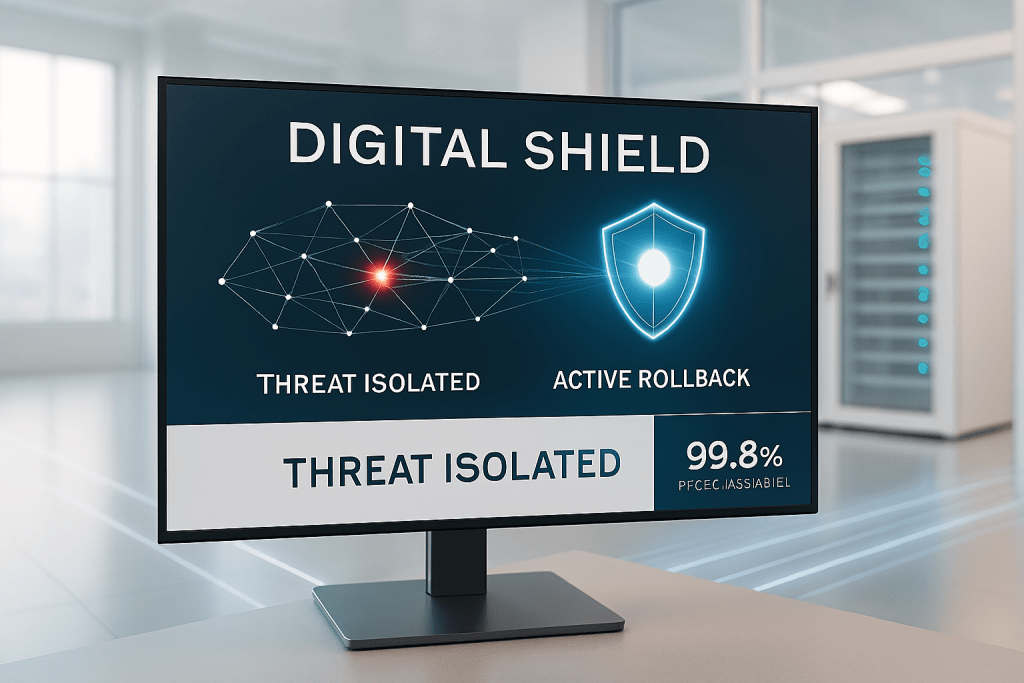
The second critical element was the concept of Zero-Touch Quarantine. We automated network isolation for hosts upon reaching specific risk thresholds. As soon as an agent detected suspicious activity consistent with ransomware patterns, the compromised endpoint was immediately severed from the corporate fabric at the logical link layer. This localized the threat to a single node, effectively preventing lateral movement across the network. In the multi-tenant environments of an MSP, where one breach can lead to cross-contamination of hundreds of segments, this reaction speed was the decisive factor for survival. We deprived attackers of their primary advantage: the time required for reconnaissance and privilege escalation.
The third and perhaps most sophisticated aspect was the activation of Active Rollback capabilities. In the event of an encryption attempt, SentinelOne didn’t just halt the attack it restored compromised files from protected, cached snapshots within milliseconds. This radically transformed the economics of cyber defense; we no longer required days of manual recovery from backups. Metrics validated by September 2023 confirmed the unprecedented efficacy of this strategy: over two years of high-intensity assaults, we achieved a 99.8% ransomware prevention rate, reducing successful encryption events to a statistical insignificance. Furthermore, our Mean Time to Respond (MTTR) plummeted by 85%, shifting from hours of manual triage to mere seconds of automated mitigation.
Through rigid EDR policies and micro-segmentation, we achieved zero lateral movement. No threat that reached an endpoint managed to escalate into a full-scale network breach. Those years taught me a singular lesson, in cybersecurity, there is no room for compromise. You either command every byte, or you wait for the phone to ring at 3:00 AM to report a catastrophe. We did not merely endure; we established a standard of resilience that allowed our clients to remain secure during the most volatile period in recent history. Our experience proved that integrating advanced algorithms with deep engineering expertise transforms a vulnerable network into an impregnable fortress capable of withstanding pressure from any state-level or criminal actor. Looking back, this technological uncompromisingness saved the Israeli industrial sector from infrastructure collapse, turning the theory of defense into the practical reality of survival.